Relaxing Card Games to Unwind Like AARP Solitaire
- By : Levzver
- Category : Brain-Boosting Games, Classic Card Games, Daily Solitaire Games, Games Like AARP Solitaire, More awesome games, Online Card Games, Solitaire for Seniors
- Tags: calming solitaire games, casual card games for adults, easy online card games, free relaxing games online, games like AARP Solitaire, peaceful solitaire alternatives, relaxing browser games, relaxing card games, solitaire games without time limit, stress relief card games
Relaxing Card Games to Unwind Like AARP Solitaire
Most people have a go-to way of decompressing after a long day. For a lot of us, it’s something quiet — a cup of tea, a few minutes of reading, or a game that doesn’t demand anything urgent from you. AARP Solitaire fits that last category almost perfectly. It’s calm, it’s familiar, and it asks just enough of your brain to keep you present without stressing you out. That combination is harder to find than it sounds.
What’s worth knowing is that solitaire isn’t the only game that hits that note. There’s a whole category of card games that work the same way — low pressure, easy to pick up, satisfying to play — and if you’ve never explored beyond the classic, you might be surprised how much variety is out there. A few of the best ones are worth knowing about.
Why Relaxing Card Games Work So Well
There’s a real difference between a game that’s easy and a game that’s genuinely relaxing, and not every game manages both. What makes card games like solitaire land in the second category is the pace. Nobody’s waiting on you. There’s no timer running in the background, no opponent getting impatient. You move when you’re ready, think as long as you want, and the game stays exactly where you left it.
The light strategy involved helps too. You’re not spacing out — you’re actually thinking, which is part of why these games feel like a reset rather than just killing time. But the thinking is gentle enough that it doesn’t create its own stress. It occupies just enough mental bandwidth to quiet the background noise of the day.
- No time limits or pressure to rush
- Simple rules that are easy to learn
- Consistent gameplay that feels familiar
- Perfect for short or long sessions
The result is a kind of game that genuinely suits all ages and moods — accessible enough to pick up after a rough day, and engaging enough that you actually want to.
Good Options If You Want to Branch Out
If AARP Solitaire is your baseline, these are worth trying. Each one keeps the same relaxed pace while offering something a little different.
Spider Solitaire
Spider is the most natural place to start. The goal — arranging cards in descending order within the same suit — takes a bit more planning than classic Klondike, but the pace stays just as unhurried. It’s the kind of game that rewards patience, which is exactly what you’re here for.
FreeCell
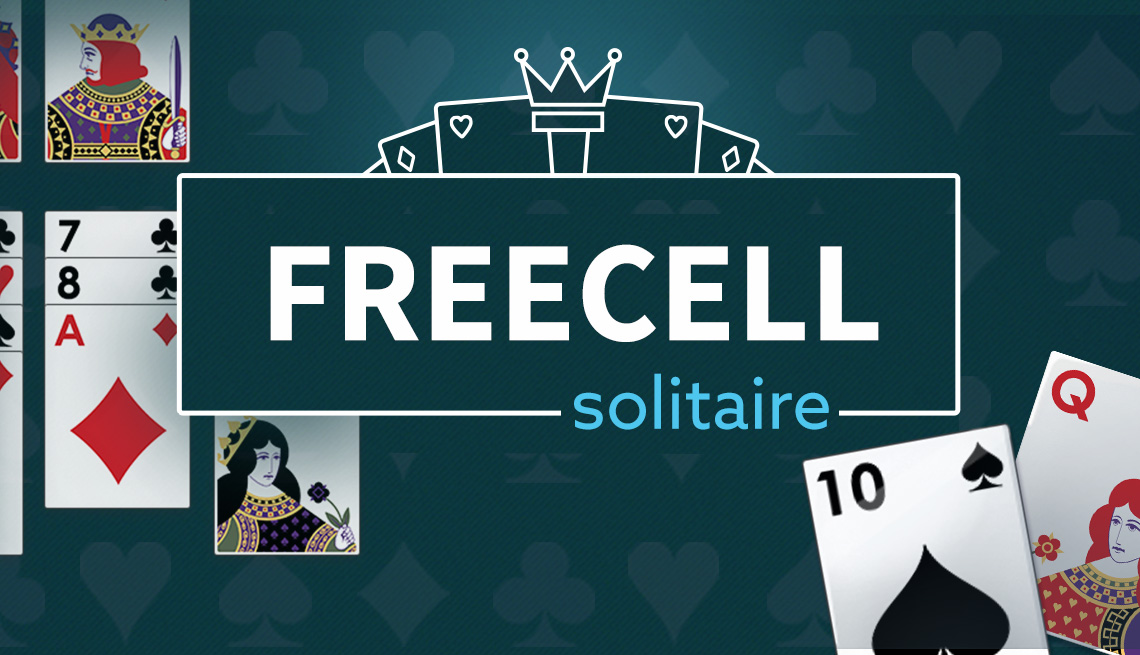
FreeCell has a devoted following, and for good reason. The entire deck is dealt face-up from the start, so there’s nothing hidden — you can see what you’re working with and plan accordingly. Almost every deal is solvable if you think it through carefully, which makes it feel more like a puzzle than a gamble. For players who find random luck frustrating, that’s a significant appeal.
TriPeaks Solitaire
TriPeaks has a slightly different rhythm — you’re clearing cards in sequence from a pyramid-style layout, and when the flow is going well, it has an almost hypnotic quality. It moves a little faster than classic solitaire but never in a way that feels pressured. Easy to learn, satisfying to play through.
Pyramid Solitaire
Pyramid is simple in the best possible way. You’re pairing cards that add up to a target number, working your way through a pyramid layout until it’s cleared. The rules take about thirty seconds to understand, which makes it ideal when you want to play without any kind of learning curve.
What These Games Actually Do for You
It sounds like a stretch to say a card game helps with stress, but there’s something real going on here. When you sit down with a game like this, your attention narrows. You’re thinking about this card, this column, this move — not the meeting you have tomorrow or the thing you forgot to do. That shift in focus is genuinely useful, even if it only lasts fifteen minutes.
The fact that you’re in complete control of the pace matters more than it might seem. You can think through a move for ten seconds or two minutes, and the game doesn’t care. That kind of low-stakes decision-making is a nice counterweight to situations where decisions actually have consequences.
And finishing a game — even a short one — provides a small but real sense of completion. On days when everything feels unresolved, that’s not nothing.
They Fit Into Real Life
One of the most practical things about games like AARP Solitaire is how little commitment they require. You’re not signing up for an hour-long session. A few minutes during a lunch break, ten minutes before bed, a quick game while you’re waiting for something — all of it works. The game doesn’t need you to be in a particular mood or have a particular amount of time.
That low barrier is part of why these games tend to stick around as habits. They’re easy to pick up and easy to put down, which means they actually get used rather than sitting forgotten.
A Closer Look at Each Game
The short descriptions above give you enough to decide whether something is worth trying, but it’s worth going a little deeper on each one for players who want to know what they’re getting into before they start.
Spider Solitaire — More Detail
Spider uses either one, two, or four suits depending on the difficulty level you choose. One suit is the gentlest introduction — cards are all the same suit, so sequencing is straightforward and the game is more about board management than anything else. Two suits introduces color complexity and requires more careful planning. Four suits is a genuinely difficult game that will test experienced players.
What makes Spider satisfying at any difficulty level is the moment a complete sequence clears from the board. You’ve built a run from King down to Ace in the same suit, and it disappears. The board opens up. That visual payoff happens repeatedly through a good game and is one of the more satisfying moments in card gaming, even though nothing dramatic is happening — it’s just cards disappearing.
The pace is naturally slower than Klondike because the sequences are longer and the planning required is more sustained. Players who find Klondike too quick and reactive often find Spider’s rhythm more comfortable. You spend more time with each position, which suits the unhurried quality most people are looking for when they reach for this kind of game.
FreeCell — More Detail
The fully visible deck is what defines FreeCell’s character. From the moment the cards are dealt, you can see everything — where every card is, what’s buried under what, which sequences are accessible and which aren’t. Nothing is hidden. That transparency creates a completely different psychological experience from Klondike, where discovery is part of the game.
The four free cells are small but important. They’re temporary holding spots — places to park a card that’s in the way while you reorganize — and how you manage them determines most of what happens. Using them too freely early on is the most common mistake. Keeping them available for moments when you genuinely need them is what separates players who win consistently from those who get stuck repeatedly in the same kinds of positions.
Almost every FreeCell deal can be solved, which is a meaningful difference from Klondike. There are a handful of known unsolvable deals in the numbered deck sequences, but in practice, if you’re not winning it’s almost always because of a decision rather than the deal. That accountability is part of what makes the game rewarding — improvement shows up in results in a direct way that luck-dependent games can’t offer.
TriPeaks — More Detail
TriPeaks moves faster than the others and that’s by design. You’re clearing three pyramid peaks by selecting cards that are one value above or below the current base card. A chain can build quickly — eight, nine, ten, nine, eight, seven, eight, nine — and when a good sequence develops it almost plays itself for a stretch.
The scoring system in most versions rewards long chains, which creates a natural incentive to plan ahead rather than just taking whatever’s available. Spotting a sequence three cards out and setting it up is more satisfying than stumbling into a long run by accident, even if the end result looks the same.
It’s the most casual of the four games mentioned here, and that’s not a criticism. Sometimes casual is exactly what’s called for. TriPeaks is a good choice for moments when you want to play something but don’t want to think too hard, and the chain-building rhythm makes it more engaging than the difficulty level might suggest.
Pyramid — More Detail
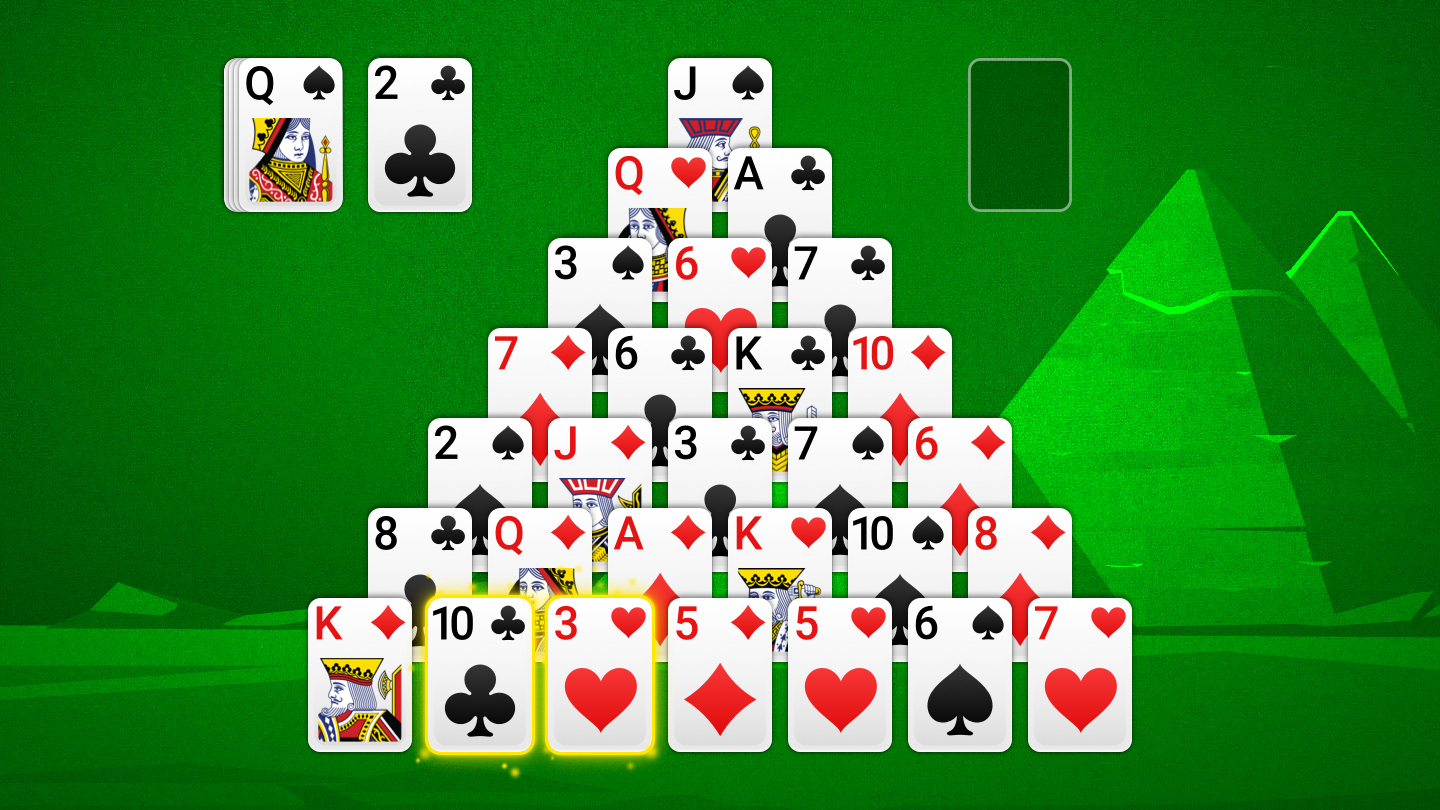
Pyramid’s rule is elegantly simple: pair cards that add up to 13, remove them from the pyramid. Kings count as 13 on their own and can be removed individually. Queens are 12, so they pair with Aces. Jacks are 11, pairing with twos. Tens pair with threes. And so on down.
The strategic layer is subtler than it first appears. Because cards in the pyramid are stacked — lower rows are blocked by the rows above them — the order in which you clear cards determines what becomes accessible. Taking a pair that opens up the next row is usually better than taking one that doesn’t change the structure, even if both pairs are legally available. That timing element gives the game more depth than the simple arithmetic rule suggests.
It’s also the shortest of the four games on this list. A Pyramid session can wrap up in two or three minutes, which makes it genuinely useful for very short breaks. Five minutes and you’ve played two complete games. That compression of the experience into a small time window is something the other games can’t quite match.
How to Choose the Right Game for the Right Moment
Having several options in this category is useful precisely because different moods call for different games. A quick mental framework for matching game to moment:
When you want something familiar and unhurried, Klondike or Spider at the one-suit level. The mechanics are comfortable, the pace is slow, and nothing is going to surprise you.
When you want to actually think but without pressure, FreeCell. The fully visible board removes uncertainty, the problem-solving is genuine, and the pace is entirely your own.
When you have five minutes and want something complete within that window, Pyramid or TriPeaks. Both games wrap up quickly and deliver a satisfying experience in a short session.
When you want flow — that state where the game almost plays itself and time disappears — TriPeaks when a good chain is developing, or Spider when a sequence is clearing smoothly. Both games have stretches that produce that quality better than the others.
When you want the most straightforward possible game with the lowest learning curve, Pyramid. Thirty seconds of rules, immediately playable, consistently enjoyable.
Making These Games Part of a Regular Routine
The reason most people develop daily habits around games like these isn’t the games themselves — it’s the structure the habit provides. A consistent ten-minute session in the morning or evening becomes a small anchor point in the day. Something that’s always there, always the same, always delivering approximately the same experience. That predictability is part of the value.
The games that stick as habits tend to be ones that are immediately accessible, self-contained enough that a session feels complete, and satisfying enough that finishing one creates a mild desire to play another. Klondike, Spider, FreeCell, TriPeaks, and Pyramid all have those qualities. None of them require a warm-up period, none of them leave you in the middle of something when the session ends, and all of them have enough variety across deals to stay interesting across many sessions.
If you’re trying to build a habit around one of them, attaching the game to something that already happens every day makes it significantly easier to maintain in the early weeks. Morning coffee is the most common pairing. Lunch break is another. The ten minutes before bed when the phone is down but sleep hasn’t come yet. Whatever already exists in your routine creates a natural slot for the game to fit into.
A Few Questions That Come Up
Are all of these games free to play online?
Yes. Spider, FreeCell, TriPeaks, and Pyramid are all available in free browser-based versions on multiple platforms. No download, no account, no cost.
Which one is best for complete beginners?
Pyramid has the simplest rules and is probably the gentlest introduction. TriPeaks is a close second. Both can be understood and played within minutes of opening them for the first time.
Which is most similar to AARP Solitaire?
Spider Solitaire, particularly at the one-suit level. The structure is similar, the pace is similar, and the goal — clearing the board through sequencing — is the same general idea.
Can these games be played on mobile?
Yes, all of them have mobile-friendly browser versions that work well on phones and tablets.
How long does a typical session take?
Pyramid and TriPeaks can wrap up in two to five minutes per game. Klondike and Spider typically run five to fifteen minutes. FreeCell varies more widely — easy deals can be solved quickly, difficult ones can take twenty minutes or more of careful work.
Final Thoughts
There’s a reason games like AARP Solitaire have held up for so long. They don’t ask much of you, but they give you something back — a few minutes of genuine quiet, a small sense of accomplishment, a break that actually feels like one.
If you want to expand beyond the classic, Spider Solitaire, FreeCell, TriPeaks, and Pyramid are all worth your time. The details differ, but the experience has the same core quality: something to do that’s calm, pleasant, and entirely on your own terms.
That’s a harder thing to find than it should be. These games deliver it reliably.