Strategy-Based Solitaire Games for Smarter Gameplay
- By : Levzver
- Category : Brain-Boosting Games, Classic Card Games, Daily Solitaire Games, Games Like AARP Solitaire, More awesome games, Online Card Games, Solitaire for Seniors
- Tags: advanced solitaire games, brain training card games, challenging solitaire games, freecell strategy tips, games like AARP Solitaire, logical card games online, skill based card games, spider solitaire strategy, strategic browser games, strategy solitaire games
Strategy-Based Solitaire Games for Smarter Gameplay
There comes a point, if you play solitaire long enough, where Klondike stops feeling like a challenge. Not because the game gets easier — the randomness makes sure of that — but because you’ve internalized it. You know which moves to make, you’ve spotted the patterns, and somewhere along the way the mental effort just… went away. Honestly, that’s worth recognizing. It means you actually got good at something.
The question is what to do with that. Most players either keep going out of habit or drift away from solitaire entirely. But there’s a third option worth knowing about: the solitaire family is enormous, and much of it is significantly harder than what most people have ever tried. If you like the thinking side of games — the planning, the patience, the satisfaction of untangling something complicated — there are variations that will push you in ways Klondike stopped doing a long time ago.
What Actually Makes a Solitaire Game Strategic
It’s worth being honest about something: a lot of solitaire games are mostly luck. The deal comes down, a few moves are available, and whether you win or lose has less to do with how cleverly you played and more to do with what cards happened to land where. There’s nothing wrong with that kind of game — sometimes you just want to zone out and flip cards — but it’s not really strategy in any meaningful sense.
Games that genuinely reward skill have a recognizable feel to them. At any given moment, there are multiple real choices in front of you — not one obvious move and three that are clearly wrong, but several plausible options that each lead somewhere different. Resources like free cells or empty columns are genuinely scarce, meaning how you allocate them matters over the long run. Decisions you make early in the game echo through to the end in ways that aren’t always visible at the time. And if you play a hundred sessions, better decision-making actually shows up in better results. That last part is the real test.

Games Worth Your Time
FreeCell
If you’ve never played FreeCell, this is the right place to start. The whole deck is laid out face-up from the beginning — no hidden cards, no surprises lurking in the stock. You’re looking at everything you have to work with, which means every mistake is yours to own. That’s either terrifying or refreshing depending on how you look at it, but it’s also what makes FreeCell such a pure test of thinking.
The four free cells at the top are the heart of the game. They’re temporary parking spots — places to stash a card that’s blocking something you need — and using them well is basically the entire skill of FreeCell. Fill them up carelessly early on and you’ll hit a wall fast. Hold them in reserve for moments when you genuinely need them and they’ll unlock sequences that looked completely stuck.
An important thing to know: nearly every FreeCell deal is actually solvable. Which means if you lose, the deal probably wasn’t the problem. That’s uncomfortable at first, but it’s also what makes improvement so satisfying — there’s a right answer in there, and getting better means finding it more consistently.
Spider Solitaire — Four Suits
Spider with one suit is pleasant. Two suits is interesting. Four suits is a completely different game, and it’s not a small step up — it’s a wall.
The reason the suit count matters so much is that in four-suit Spider, you can only move cards together as a group if they’re the same suit. Mixed sequences — a black 7 on a red 8, perfectly legal in Klondike — become dead weight that you can’t shift. The tableau fills up fast with cards that look useful but can’t be moved, and the game quickly becomes an exercise in damage control.
The players who do well at four-suit Spider are the ones who think three or four moves ahead as a matter of habit, not something they do occasionally. You have to see consequences before you create them, because by the time a problem is obvious, it’s usually already too late to fix it cleanly. It’ll humble you early. It’ll reward you later. That arc is what makes it worth playing.
Yukon Solitaire
Yukon looks like Klondike at first — same basic layout, cards arranged in tableau columns, same goal. But two things are different, and both of them matter enormously.
First, you can move groups of cards between columns even if they’re not in a proper sequence, as long as the top card of the group you’re placing is valid. That sounds like it should make the game easier, but in practice it just means there are more decisions to evaluate at every turn. More flexibility creates more complexity, not less.
Second — and this is the bigger one — there’s no stock pile. All the cards are dealt into the tableau at the start, face-up or face-down. There’s no fallback. No reserve deck to draw from when you’re stuck. What’s on the board at the beginning is everything you’re going to get, so the game becomes about figuring out what to do with exactly these cards, in exactly this configuration. It has a logic-puzzle quality that most solitaire games don’t quite reach.
Forty Thieves
Forty Thieves has a reputation, and it earns it. Two full decks, ten columns across the tableau, one card movable at a time, and tableau building by matching suit rather than alternating color. The win rate is low. Even experienced players who know what they’re doing don’t complete it most of the time. That’s not a bug — that’s the point.
There’s something valuable about a game that doesn’t let you win easily. Forty Thieves keeps raising the bar. When you finally do get through it — and you will, eventually — it actually means something, in a way that a higher win rate would undermine. Getting better at it is a real project that takes real time. If you’re the kind of person who finds that appealing rather than discouraging, this is your game.
A Few Things That Apply to All of Them
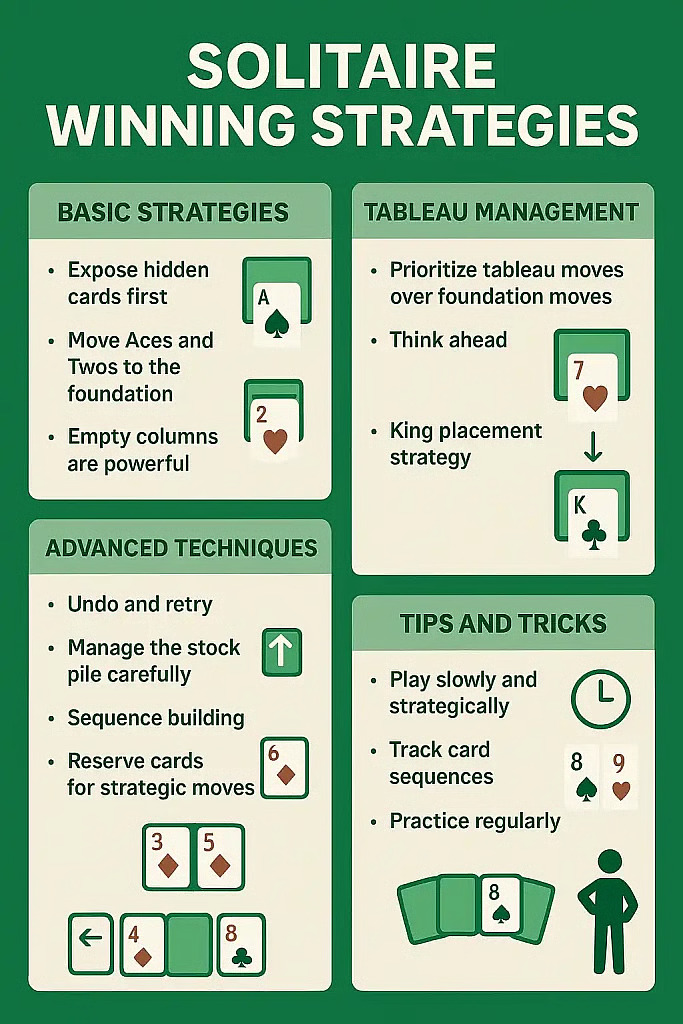
Some principles carry over from Klondike and apply everywhere.
Uncovering hidden cards is almost always the right instinct. More information opens up more options, and options are what you’re managing in all of these games. A face-down card is a locked door. Everything else being equal, open it.
Guard your open spaces. An empty column or an available free cell sitting unused feels like wasted potential, and the natural urge is to fill it. Fight that. Open space held in reserve is almost always worth more than whatever slightly useful thing you could put there right now. The move that fills your last free cell had better be worth it, because it might close off the one path that would have won the game.
Slow down at forks in the road. Rushing through these games is how winnable positions get thrown away. Before any significant move, it takes maybe thirty seconds to trace out where it leads — that time is almost always worth it.
And when you lose, try to figure out why before you start the next game. Solitaire losses usually aren’t random. Something specific caused the position to collapse — a cell that got used too early, a sequence that got buried under cards you couldn’t move. Identifying it once means you’ll catch it faster the next time. That’s the actual learning loop, and it’s a faster path to improvement than just playing more games.
How to Transition Between Games Without Starting From Zero
One thing that holds players back from trying harder solitaire variations is the assumption that switching games means starting over as a complete beginner. That’s not really how it works.
The core instincts you develop in Klondike transfer directly. Reading the board before acting, prioritizing moves that open up options over moves that just look good right now, being careful with scarce resources — all of that carries over. What changes is the specific mechanics and the specific constraints you’re working within.
FreeCell is the easiest transition because it shares the most with Klondike. Same alternating color sequencing, same foundation goal, same general feel. The differences are meaningful but not jarring. Most Klondike players are playing passable FreeCell within a few sessions.
Yukon is the next most natural step. The layout is familiar, the goal is identical, and the added flexibility of moving non-sequential groups actually makes some things easier at first. The absence of a stock pile is the adjustment — without that safety net, the game demands more from the initial board reading.
Spider and Forty Thieves are steeper climbs and worth treating as genuinely new games rather than variations. Spider’s suit-matching rules change how sequences work in ways that take time to internalize. Forty Thieves’ two-deck structure and strict movement rules require building new habits almost from scratch. Expect a real learning curve on both and be patient with yourself through it.
Building a Rotation That Works
A lot of experienced card game players end up with a rotation of two or three games they cycle through rather than committing exclusively to one. There are good reasons for this beyond just avoiding boredom.
Different games exercise different aspects of the same underlying skill set. FreeCell is heavily sequential — you’re tracing chains of consequences through a fully visible board. Spider is more about managing multiple simultaneous threads without letting any of them collapse. Yukon rewards spatial thinking and the ability to see restructuring opportunities across the whole board. Forty Thieves is primarily about resource conservation under strict constraints.
Playing all of them regularly means different cognitive muscles stay active in ways that a single game can’t provide. You also come back to each one with fresh eyes after time away, which tends to produce better play than grinding through the same game repeatedly until the patterns become reflexive.
A practical rotation might look like this: FreeCell as the daily game you reach for by default, Spider for longer sessions when you want something that requires more sustained attention, Yukon as the middle-ground option when you want Klondike difficulty with a logic-puzzle feel, and Forty Thieves as the occasional serious challenge you return to when you want to test how much you’ve actually improved.
None of that is a prescription. The right rotation is whatever you’ll actually play consistently.
What Progress Actually Looks Like
People expect improvement in games to feel obvious — win rates going up, sessions getting faster, difficult positions resolving cleanly. Sometimes that happens, but it’s not the most reliable signal.
More often, improvement in strategy-based solitaire shows up in subtler ways. You start noticing problems earlier — before they become crises rather than after. Decisions that used to feel agonizing become easier because you’ve developed better intuitions about which options are genuinely good versus which ones just look appealing. You lose differently — instead of running out of moves with most of the board still standing, you get further before things collapse, and the reason for the collapse is clearer.
That last point is worth sitting with. Losing closer to the end, for a reason you can identify, is progress. It means the early and middle game are coming together and there’s a specific late-game issue to solve. That’s a much better position than losing early for reasons that are hard to diagnose.
The players who improve fastest in these games are the ones who treat losses as information rather than frustration. Not in a forced, relentlessly positive way — losing is annoying, and that’s fine — but with enough curiosity to ask what specifically went wrong before moving on. That habit compounds over time into genuinely better play.
Playing These Games for Relaxation vs. Challenge
This might seem like a contradiction — if these games are harder, how can they be relaxing? But the two aren’t mutually exclusive, and understanding the difference helps you get the most out of whichever mode you’re in.
FreeCell, even though it’s more demanding than Klondike, can be deeply calming once you’ve played enough to be comfortable with it. The fully visible board removes uncertainty, and the problem-solving process has a satisfying rhythm when things are going well. Players who find Klondike’s luck element frustrating often find FreeCell more relaxing precisely because outcomes feel more controllable.
Spider at the one or two suit level is probably the most genuinely meditative of the group — long chains of card movement, satisfying sequences building and clearing, a pace that rewards patience without demanding intensity.
Yukon sits somewhere in between depending on the deal. Some boards are open and tractable; others are dense puzzles that require real concentration. The variability itself is part of what keeps it interesting.
Forty Thieves is honest about being a challenge. It doesn’t pretend to be relaxing. But there’s a particular kind of satisfaction in sitting down with a difficult problem and working through it methodically, and that experience is its own form of mental rest for some people.
The point is that harder doesn’t automatically mean more stressful. It depends on the game, your comfort level with it, and what you’re looking for from the session.
A Few Frequently Asked Questions
Which game should I try first if I’ve only played Klondike?
FreeCell. It’s the most natural transition, it’s genuinely strategic, and nearly every deal is solvable — which means improvement shows up in results in a way that luck-dependent games don’t allow.
Are these games actually free to play online?
Yes, all of them. FreeCell, Spider, Yukon, and Forty Thieves are available on multiple platforms in browser-based versions with no download or account required.
How long does it take to get good at FreeCell?
Most players are comfortable with the basics within a week of regular play. Genuine proficiency — consistently finding solutions to difficult deals — takes longer, but the improvement curve is steady rather than frustrating.
Is four-suit Spider actually winnable?
Yes, though the win rate is low even for experienced players. Some deals are extremely difficult and a small percentage are effectively impossible, but most can be solved with careful play. The challenge is getting your play careful enough to find the path.
What’s the best way to get better at these games?
Play regularly, use the undo feature deliberately to explore what different choices lead to, and take a moment after each loss to identify what specifically went wrong. Those three habits together produce faster improvement than just playing more games.
Final Thoughts
None of this is a case against regular solitaire. If Klondike is your daily routine and you enjoy it, keep enjoying it. But if you’ve found yourself wanting more resistance from the game — more moments where you have to actually think — these four variations are worth trying. FreeCell is the best first step if you want the sharpest translation of the strategic thinking you’ve already developed. Forty Thieves is where you go when you’re ready to be seriously challenged.
All of them are free to play in a browser. The learning curve on each one is real, but that’s exactly what makes getting through it feel like something.